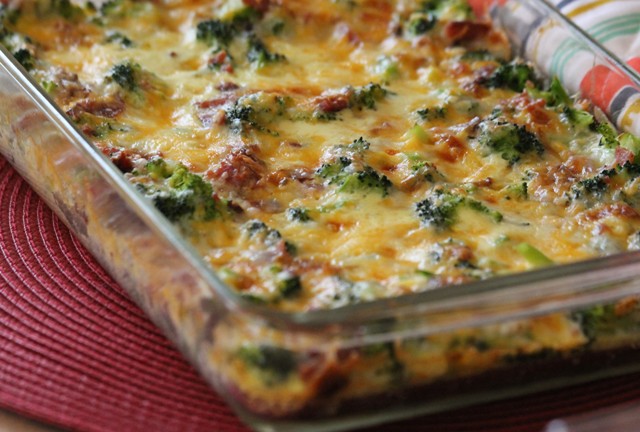
Broccoli and cheese egg bake

broccoli-cheese-bake

This delicious egg bake is so easy! Perfect for holiday brunch or potlucks. Prepare in advance if you wish, and pop in the oven before you want to serve your guests. Makes 12 single servings.

 Prep Time: 10 minutes
 Cook Time: 35 minutes
 Total Time: 45 minutes
 Servings: 12 people

Ingredients

  • 12 eggs
  • 1 cup milk of choice (I used unsweetened almond milk but also works with cows milk)
  • 1 small onion diced
  • 2 heaping cups broccoli florets chopped
  • 1 1/2 cups shredded cheese of choice, more to taste if desired (recommend Mexican blend or cheddar)
  • 1/4 tsp salt more to taste
  • 1/4 tsp ground black pepper more to taste

Instructions

  1. Preheat oven to 400 degrees F. Lightly spray a 9×13 baking dish with oil.

  2. In a large bowl, whisk eggs and milk together. Add chopped broccoli and onions, shredded cheese, and salt and pepper to taste. Mix until well combined.

  3. Pour into baking dish and bake for approximately 25-30 minutes or until eggs are cooked through. Let dish stand for 5-10 minutes before serving.

Recipe Notes

Nutrition Facts per 1 of 12 servings: 117 kcal,

Fat: 8g

Carb: 3g

Fiber: 1g

Sugar: 1g

Protein: 9g

*please note nutrition facts are estimated and may not be exact, and these will change if using cows milk or other additional ingredients (they are calculated with almond milk here)

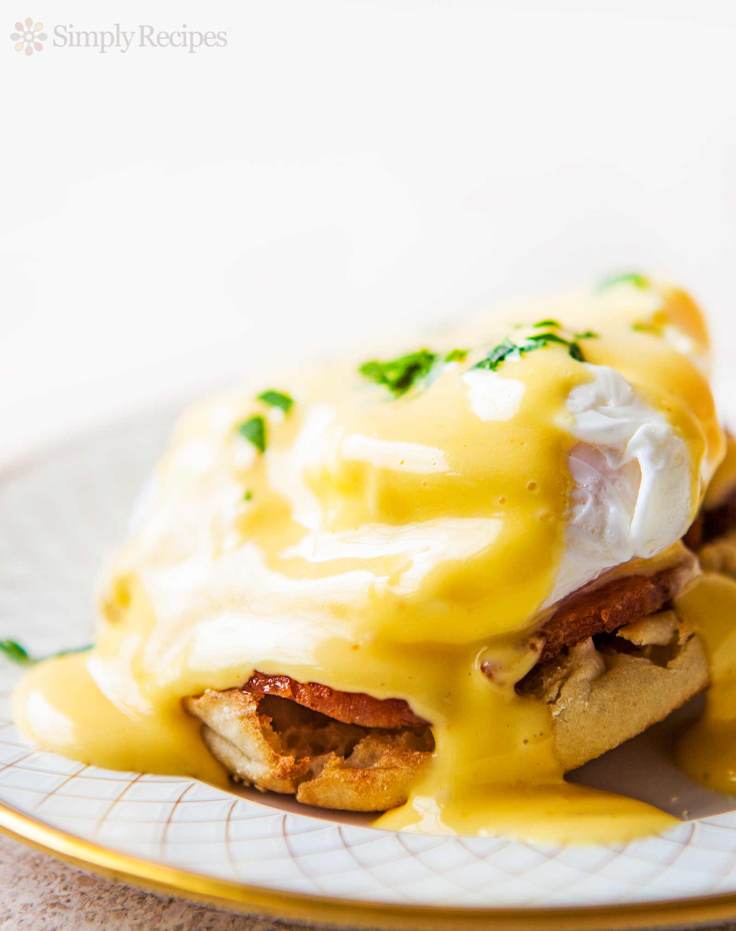
Egg benedict

eggs-benedict-vertical-a-1600

INGREDIENTS

  • 8 pieces of bacon or 4 pieces of Canadian bacon
  • 2 tablespoons chopped parsley, for garnish
  • 4 eggs
  • 2 teaspoons white or rice vinegar
  • 2 English muffins
  • Butter

Blender Hollandaise

  • 10 Tbsp unsalted butter
  • 3 egg yolks
  • 1 Tbsp lemon juice
  • 1/2 teaspoon salt
  • Dash of cayenne or tabasco

METHOD

1 Cook the bacon: Heat a large skillet on medium low heat. Add the strips of bacon or the slices of Canadian bacon. Slowly fry, turning occasionally, until the bacon is browned on both sides, and if using strip bacon, much of the fat is rendered out (about 10 minutes).

Use tongs or a fork to remove the bacon from the pan, set on a paper towel to absorb the excess fat.

Don’t pour the bacon fat left in the pan down the drain! Either sop it up with paper towels when it has cooled a bit, or pour it into a jar to be used later (see rendering bacon fat).

2 Bring poaching water to a simmer: While the bacon is cooking, bring a large saucepan two-thirds-filled with water to a boil, then add the vinegar. Bring the water to a boil again, then lower the heat to a bare simmer.

3 Make Hollandaise sauce in blender: To make blender hollandaise, melt 10 Tbsp unsalted butter.

Put 3 egg yolks, a tablespoon of lemon juice, 1/2 teaspoon salt in a blender, blend on medium to medium high speed for 20-30 seconds, until eggs lighten in color.

Turn blender down to lowest setting, slowly dribble in the hot melted butter, while continuing to blend. Taste for salt and acidity and add more salt or lemon juice to taste.

Transfer it to a container you can use for pouring and set it on a warm—but not hot—place on or near the stovetop.

4 Poach the eggs: Here is an easy method for poaching eggs. Essentially, working one egg at a time you crack an egg into a small bowl and slip it into the barely simmering water. Once it begins to solidify, you can slip in another egg, until you have all four cooking.

Turn off the heat, cover the pan, and let sit for 4 minutes. (Remember which egg went in first, you’ll want to take it out first.) When it comes time to remove the eggs, gently lift out with a slotted spoon. Note that the timing is a little variable on the eggs, depending on the size of your pan, how much water, how many eggs, and how runny you like them. You might have to experiment a little with your set-up to figure out what you need to do to get the eggs exactly the way you like them.

5 Toast English muffins: As soon as all the eggs are in the poaching water, begin toasting your English muffins. If you can’t get all the muffins toasted by the time the eggs are ready, gently remove the eggs from the poaching water and set in a bowl.

6 Assemble your Eggs Benedict: To assemble, butter one side of an English muffin. Top with two slices of bacon or 1 slice of Canadian bacon. You can trim the bacon to fit the muffin if you’d like.

Put a poached egg on top of the bacon, then pour some hollandaise over. Sprinkle some parsley over it all and serve at once.

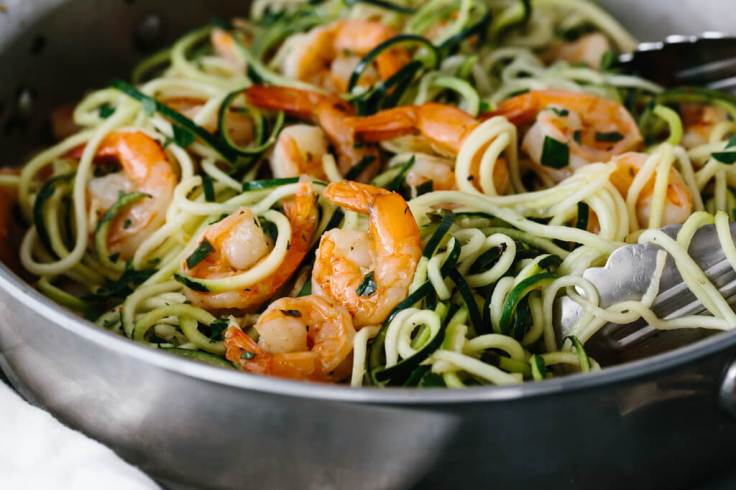
Zucchini Pasta with Shrimp

zucchini-noodles-pasta-lemon-garlic-shrimp-4

Healthy zucchini noodles “zucchini pasta” are tossed with lemon garlic shrimp for an easy, family favorite dinner recipe. It’s naturally gluten-free and paleo-friendly and can easily be made Whole30 by replacing the white wine with chicken broth. Watch the recipe video above.

INGREDIENTS

—————————————————————————————————————————————–

  • 4 medium zucchini
  • 1.5 lb (approx 30) raw shrimp, peeled and deveined
  • 2 tbsp olive oil
  • 4 garlic cloves, finely chopped
  • 2 tbsp butter or ghee
  • 1 lemon, juice and zest
  • 1/4 cup white wine (or chicken broth)
  • 1/4 cup chopped parsley
  • pinch of red pepper flakes
  • salt and pepper, to taste

DIRECTIONS

  1. Wash and cut the ends of the zucchini. Using a spiralizer, make the zucchini pasta. Then, set aside.
  2. Heat the oil in a large pan over medium-high heat. Add the shrimp in one flat layer and sprinkle with salt and pepper. Cook for one minute without stirring, so the bottom side gets a little crispy.
  3. Add the chopped garlic, then stir the shrimp for another minute or two to cook the other side. Use a large spoon or tongs to remove the shrimp to a plate.
  4. Add the butter, lemon juice and zest, red pepper flakes and white wine to the pan. Bring to a simmer for 2-3 minutes while stirring.
  5. Stir in the parsley, then add the zucchini pasta and toss for 30 seconds to warm it up. Add the shrimp back to the pan and stir for another minute. Serve immediately.

LISA’S TIPS

If you’ve read my post on How to Make and Cook Zucchini Noodles you know I’m not a fan of cooking zucchini noodles. They become limp and soggy very quickly. So all you want to do is heat up the zucchini pasta without thoroughly cooking. That keeps it crisp and al dente.

The spiralizer I use in this recipe and all my veggie noodle recipes is my 3-Blade Paderno Spiralizer.

I always get asked if zucchini pasta recipes can be frozen and reheated. Unfortunately, due to the fact that zucchini is 95% water, these are not the best recipes to freeze/reheat once made.

NUTRITION INFORMATION

Yield: 4 servings, Serving Size: 1/4 of recipe

  • Amount Per Serving:
  • Calories: 306.2
  • Total Fat: 14.5g
  • Saturated Fat: 5g
  • Cholesterol: 289mg
  • Sodium: 230.7mg
  • Carbohydrates: 12.3g
  • Fiber: 3.4g
  • Sugar: 8.4g
  • Protein: 27.4g

American Skincare Routine

970-african-american-skin-care-routines-tips

This routine should sound familiar. “The American girl aims for fresh, healthy, young-looking skin,” says Kim Robertson, VP of customer experience and education at Kiehl’s. Preventing the signs of aging is a key priority for her, as is sticking to natural ingredients whenever possible. Though the everyday American girl isn’t quite as informed about the science of skincare as the average Korean, she is still concerned with avoiding harmful chemicals. And because we Americans like things to happen fast, she’s driven by the promise of overnight results.

A gentle yet thorough cleanser and toner are essential to the American girl’s routine, says Robertson. After toner, her focus is anti-aging—softening fine lines and restoring that coveted youthful “glow.” For this, she might reach for a concentrated serum, says Robertson, like Kiehl’s Powerful-Strength Line-Reducing Concentrate ($60), which neutralizes free radicals to fight aging.

Another classic American step is to do a detoxifying mask once a week, like GlamGlow’s Supermud Clearing Treatment ($69) or Tata Harper’s Purifying Treatment ($65). And no American skincare routine is complete without night cream. Retinol-packed moisturizers, like RoC’s Retinol Correxion Deep Wrinkle Night Cream ($20), are always especially popular.

French Skincare Routine

vbnd4miuoxox

According to Clarins expert Christopher Truffa, “less is more” when it comes to French nighttime skincare. The goal is to use as few products as possible, that are as gentle as possible, to wake up with skin that is “clean, baby soft, hydrated, and rested.”

“We are big on pharmacies and buy most of our beauty products there,” adds French girl Clémence Polès, creator of the street style blog Passerbuys. Favorite brands include Caudalie, Nuxe, and La Roche-Posay.

The typical nighttime routine in France takes only two or three steps, though this expands with age. Twenty-something Polès sticks to a gentle cleanser, like Caudalie’s Instant Foaming Cleanser ($28) or Bioderma’s Créaline H2O ($26), followed by moisturizer. “And when I say moisturize, I really mean moisturize,” she says. “Face, body, hands—the whole deal.” At night, Polès typically opts for a face oil. Her favorite is Nuxe Huile Prodigieuse ($24), which she also applies to the ends of her hair.

Valerie Grandury, founder of French skincare brand Odacité, says that as French women enter their 30s, they start to add a few more products. “Night cream, eye cream, and a serum when you’re over 30 are all essential,” she says. Try Odacité’s Ac+R Youthful Glow ($55).


Korean Skincare Routine

image

Korean women are famous for their 10-step skincare routines. But what inspires such an intensive process? Alicia Yoon, founder of Asian beauty boutique Peach & Lily, says that Korean women know that the skin regenerates most actively while you sleep, between the hours of 10 p.m. and 2 a.m. Their nighttime skincare routines are designed to support that process.

Korean women’s nighttime routines are highly individualized, according to skin type, season, and other wellness needs. Generally speaking, the typical routine starts with making sure the skin is “thoroughly and gently cleansed down to the pores.” “Ensuring that all makeup and impurities are removed is a priority,” Yoon says. That means double cleansing with a nourishing cleansing oil, followed by a gently exfoliating water-based cleanser to remove any residue and prep the skin for next steps.

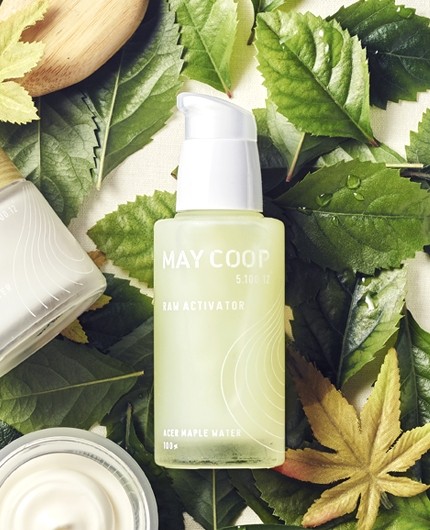
Once the skin is clean and ready to absorb active ingredients, Korean women move onto essences, serums, and masks. Yoon recommends Shangpree’s S-Energy Long Lasting Concentrated Serum ($120) for firming and plumping and May Coop’s Raw Activator ($60) for softer, stronger skin. Sheet masks are also staple in the Korean nighttime routine. Model Lee Sa-Bi has used one every night for the last eight years and recommends masks by Cremorlab and Shangpree.

For Korean women, skincare doesn’t stop at products. “The skin can also be given a boost by doing facial massages or exercises to help stimulate circulation and release toxins,” says Yoon.

Though Korean skincare routines vary widely, the last step is almost always moisturizer. “To seal in all the action,” says Yoon. Blogger Chriselle Lim recommends Sisley’s Hydra-Global Intense Anti-Aging Hydration ($225) and Black Rose Precious Face Oil ($235), which provide an extra dose of moisture, plus aromatherapy to put your mind at rest.

img_0577banner2_20171221111625nuoc-than-mau-moi-mua-he-2018-sk-ii-limited-edition-facial-treatment-essence-230ml-little-red-symbol-1may-coop-raw-activator_2

10 Health Benefits of Low-Carb and Ketogenic Diets

1. Low-Carb Diets Kill Your Appetite (in a Good Way)

Hunger is the single worst side effect of dieting.

It is one of the main reasons why many people feel miserable and eventually give up on their diets.

One of the best things about eating low-carb is that it leads to an automatic reduction in appetite (1).

The studies consistently show that when people cut carbs and eat more protein and fat, they end up eating much fewer calories.

In fact… when researchers are comparing low-carb and low-fat diets in studies, they need to actively restrict calories in the low-fat groups to make the results comparable (2).

BOTTOM LINE:When people cut carbs, their appetite tends to go down and they often end up eating much fewer calories without trying.

2. Low-Carb Diets Lead to More Weight Loss

Cutting carbs is one of the simplest and most effective ways to lose weight.

Studies show that people on low-carb diets lose more weight, faster, than people on low-fat diets… even when the low-fat dieters are actively restricting calories.

One of the reasons for this is that low-carb diets tend to get rid of excess water from the body. Because they lower insulin levels, the kidneys start shedding excess sodium, leading to rapid weight loss in the first week or two (34).

In studies comparing low-carb and low-fat diets, the low-carbers sometimes lose 2-3 times as much weight, without being hungry (56).

Low-carb diets appear to be particularly effective for up to 6 months, but after that the weight starts creeping back up because people give up on the diet and start eating the same old stuff (7).

It is much more appropriate to think of low-carb as a lifestyle, NOT a diet. The only way to succeed in the long-term is to stick to it.

However, some people may be able to add in healthier carbs after they have reached their goal weight.

BOTTOM LINE:Almost without exception, low-carb diets lead to more weight loss than the diets they are compared to, especially in the first 6 months.

3. A Greater Proportion of The Fat Lost Comes From The Abdominal Cavity

Not all fat in the body is the same.

It’s where that fat is stored that determines how it will affect our health and risk of disease.

Most importantly, we have subcutaneous fat (under the skin) and then we have visceral fat (in the abdominal cavity).

Visceral fat is fat that tends to lodge around the organs.Having a lot of fat in that area can drive inflammation, insulin resistance and is believed to be a leading driver of the metabolic dysfunction that is so common in Western countries today (8).

Low-carb diets are very effective at reducing the harmful abdominal fat.

Not only do they cause more fat loss than low-fat diets, an even greater proportion of that fat is coming from the abdominal cavity (9).

Over time, this should lead to a drastically reduced risk of heart disease and type 2 diabetes.

BOTTOM LINE:A large percentage of the fat lost on low-carb diets tends to come from the harmful fat in the abdominal cavity that is known to cause serious metabolic problems.

4. Triglycerides Tend to Go Way Down

Triglycerides are fat molecules.

It is well known that fasting triglycerides, how much we have of them in the blood after an overnight fast, are a strong heart disease risk factor (10).

Perhaps counter intuitively, the main driver of elevated triglycerides is carbohydrate consumption, especially the simple sugar fructose (111213).

When people cut carbs, they tend to have a very dramatic reduction in blood triglycerides (1415).

Compare this to low-fat diets, which can cause triglycerides to go up in many cases (1617).

BOTTOM LINE:Low-carb diets are very effective at lowering blood triglycerides, which are fat molecules in the blood and a well known risk factor for heart disease.

5. Increased Levels of HDL (the “Good”) Cholesterol

High-density lipoprotein (HDL) is often called the “good” cholesterol.

It’s actually wrong to call it “cholesterol”… all cholesterol molecules are the same.

HDL and LDL refer to the lipoproteins that carry cholesterol around in the blood.

Whereas LDL carries cholesterol from the liver and to the rest of the body, HDL carries cholesterol away from the body and to the liver, where it can be reused or excreted.

It is well known that the higher your levels of HDL, the lower your risk of heart disease will be (181920).

One of the best ways to increase HDL levels is to eat fat… and low-carb diets include a lot of fat (212223).

Therefore, it is not surprising to see that HDL levels increase dramatically on low-carb diets, while they tend to increase only moderately or even go down on low-fat diets (2425).

The Triglycerides:HDL ratio is another very strong predictor of heart disease risk. The higher it is, the greater your risk of heart disease is (262728).

By lowering triglycerides and raising HDL levels, low-carb diets lead to a major improvement in this ratio.

BOTTOM LINE:Low-carb diets tend to be high in fat, which leads to an impressive increase in blood levels of HDL, often referred to as the “good” cholesterol.

6. Reduced Blood Sugar and Insulin Levels, With a Major Improvement in Type 2 Diabetes

When we eat carbs, they are broken down into simple sugars (mostly glucose) in the digestive tract.

From there, they enter the bloodstream and elevate blood sugar levels.

Because high blood sugars are toxic, the body responds with a hormone called insulin, which tells the cells to bring the glucose into the cells and to start burning or storing it.

For people who are healthy, the quick insulin response tends to minimize the blood sugar “spike” in order to prevent it from harming us.

However… many, many people have major problems with this system. They have what is called insulin resistance, which means that the cells don’t “see” the insulin and therefore it is harder for the body to bring the blood sugar into the cells (29).

This can lead to a disease called type 2 diabetes, when the body fails to secrete enough insulin to lower the blood sugar after meals. This disease is very common today, afflicting about 300 million people worldwide (30).

There is actually a very simple solution to this problem… by cutting carbohydrates, you remove the need for all of that insulin. Both blood sugars and insulin go way down (3132).

According to Dr. Eric Westman, who has treated many diabetics using a low-carb approach, he needs to reduce their insulin dosage by 50% on the first day (33).

In one study in type 2 diabetics, 95.2% had managed to reduce or eliminate their glucose-lowering medication within 6 months (34).

If you are currently on blood sugar lowering medication, then talk to your doctor before making changes to your carbohydrate intake, because your dosage may need to be adjusted in order to prevent hypoglycemia.

BOTTOM LINE:The best way to lower blood sugar and insulin levels is to reduce carbohydrate consumption. This is also a very effective way to treat and possibly even reverse type II diabetes.

7. Blood Pressure Tends to Go Down

Having elevated blood pressure (hypertension) is an important risk factor for many diseases.

This includes heart disease, stroke, kidney failure and many others.

Low-carb diets are an effective way to reduce blood pressure, which should lead to a reduced risk of these diseases and help you live longer (3435).

BOTTOM LINE:Studies show that reducing carbs leads to a significant reduction in blood pressure, which should lead to a reduced risk of many common diseases.

8. Low-Carb Diets Are The Most Effective Treatment Known Against Metabolic Syndrome

The metabolic syndrome is a medical condition that is highly associated with the risk of diabetes and heart disease.

It is actually a collection of symptoms:

  • Abdominal obesity
  • Elevated blood pressure
  • Elevated fasting blood sugar levels
  • High triglycerides
  • Low HDL levels

The good news is… all five symptoms improve dramatically on a low-carb diet (3637).

Unfortunately, the government and major health organization still recommend a low-fat diet for this purpose, which is pretty much useless because it does nothing to address the underlying metabolic problem.

BOTTOM LINE:Low-carb diets effectively reverse all 5 key symptoms of the metabolic syndrome, a serious condition known to predispose people to heart disease and type 2 diabetes.

9. Low-Carb Diets Improve The Pattern of LDL Cholesterol

Low-density lipoprotein (LDL) is often referred to as the “bad” cholesterol (again, it is actually a protein).

It is known that people who have high LDL are much more likely to have heart attacks (3839).

However… what scientists have now learned is that the type of LDL matters. Not all of them are equal.

In this regard, the size of the particles is important. People who have mostly small particles have a high risk of heart disease, while people who have mostly large particles have a low risk (404142).

It turns out that low-carb diets actually turn the LDL particles from small to large, while reducing the number of LDL particles floating around in the bloodstream (43).

BOTTOM LINE:When you eat a low-carb diet, your LDL particles change from small (bad) LDL to large LDL – which is benign. Cutting carbs may also reduce the number of LDL particles floating around in the bloodstream.

10. Low-Carb Diets Are Therapeutic For Several Brain Disorders

It is often claimed that glucose is necessary for the brain… and it’s true.

Some part of the brain can only burn glucose. That’s why the liver produces glucose out of protein if we don’t eat any carbs.

But a large part of the brain can also burn ketones, which are formed during starvation or when carbohydrate intake is very low.

This is the mechanism behind the ketogenic diet, which has been used for decades to treat epilepsy in children who don’t respond to drug treatment (44).

In many cases, this diet can cure children of epilepsy. In one study, over half of children on a ketogenic diet had a greater than 50% reduction in seizures. 16% of the children became seizure free (45).

Very low-carb/ketogenic diets are now being studied for other brain disorders as well, including Alzheimer’s disease and Parkinson’s disease (46).

Take Home Message

Few things are as well established in nutrition science as the immense health benefits of low-carb and ketogenic diets.

Source: https://www.healthline.com/nutrition/10-benefits-of-low-carb-ketogenic-diets#section3

Create a free website or blog at WordPress.com.

Up ↑

Design a site like this with WordPress.com
Get started